
Hydration: how much water do you actually need?
If you’ve ever heard “6–8 glasses a day”, “2 litres”, and “35 ml per kg” quoted as the answer — you’re not imagining it. Hydration guidance varies because your fluid needs change with body size, activity, temperature, illness, and some medications.
The UK baseline: 6–8 drinks and a simple pee check
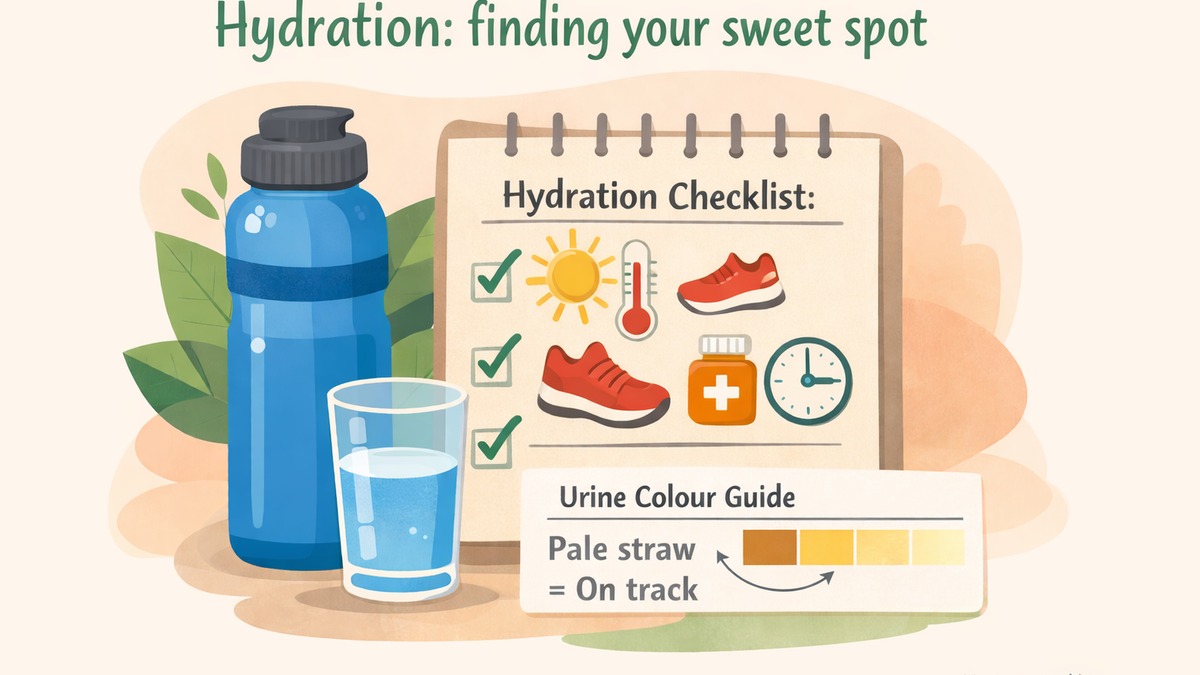
In the UK, the Eatwell Guide suggests aiming for 6–8 cups or glasses of fluid per day. The NHS also shares a practical self-check: you’re generally well hydrated when your pee is a clear, pale yellow. Tea and coffee count, as do other low-sugar drinks — and we also get water from foods (especially fruit, veg, soups and yoghurt).
Why you’ll see different numbers (including 25–35 ml/kg)
Some organisations use daily “adequate intake” targets for total water (from food + drinks):
- EFSA (Europe): about 2.0 L/day for women and 2.5 L/day for men (total water from food + fluids).
- US National Academies: about 2.7 L/day for women and 3.7 L/day for men (total water), estimating roughly ~19% comes from food.
Alongside these population targets, you’ll also see a body-weight “rule of thumb” used as a starting point in healthcare settings. The NICE intravenous (IV) fluids guideline for adults in hospital uses 25–30 ml per kg per day as routine maintenance, and advises considering 20–25 ml/kg/day for people who are older or frail, or who have renal impairment or cardiac failure.
That’s why “25 ml/kg” and “up to 35 ml/kg” both show up — they can be reasonable starting points, but context matters.
A simple way to personalise (without obsessing)
Use a starting range, then adjust based on your day and your body:
- 25–30 ml/kg/day: a useful starting point for smaller bodies, cooler days, sedentary routines, or older/frailer adults (or if a clinician has advised fluid caution).
- 30–35 ml/kg/day: often suits more active days, warm environments, heavy sweaters, or when you’re unwell (fever, vomiting, diarrhoea) and losing more fluid.
Example: A 70 kg adult × 30 ml/kg = ~2.1 L/day (remember some comes from food).
The best real-life hydration check
The British Dietetic Association highlights urine colour as a useful indicator: aim for pale straw. Darker urine can suggest you need more fluid (but if you’re concerned, seek medical advice). You can also use thirst, energy levels, and how you feel during exercise as extra clues.
A quick safety note
More isn’t always better. If you have kidney or heart conditions, are taking fluid-affecting medication (for example, diuretics), or you’re pregnant or breastfeeding, your ideal intake may differ. Follow personalised advice from your GP or specialist team.
References
- NHS. Water, drinks and hydration. https://www.nhs.uk/live-well/eat-well/eatwell-guide/water-drinks-nutrition/
- British Dietetic Association (BDA). Fluid (water and drinks) and hydration. https://www.bda.uk.com/resource/fluid-water-drinks.html
- European Food Safety Authority (EFSA). Scientific Opinion on Dietary Reference Values for water (2010). https://efsa.onlinelibrary.wiley.com/doi/10.2903/j.efsa.2010.1459
- National Academies of Sciences, Engineering, and Medicine. Dietary Reference Intakes for Water, Potassium, Sodium, Chloride, and Sulfate (2005) – Summary. https://www.nationalacademies.org/read/10925/chapter/2
- NICE. Intravenous fluid therapy in adults in hospital (CG174) – Key priorities (routine maintenance: 25–30 ml/kg/day; consider less for older/frail/renal/cardiac risk). https://www.nice.org.uk/guidance/cg174/chapter/key-priorities-for-implementation
Disclaimer
This blog is for general education only and is not medical advice. Hydration needs vary between individuals and can be affected by medical conditions, medications, pregnancy/breastfeeding, and activity levels. If you have concerns about your fluid intake or symptoms of dehydration (or are advised to restrict fluids), speak with a qualified healthcare professional.