
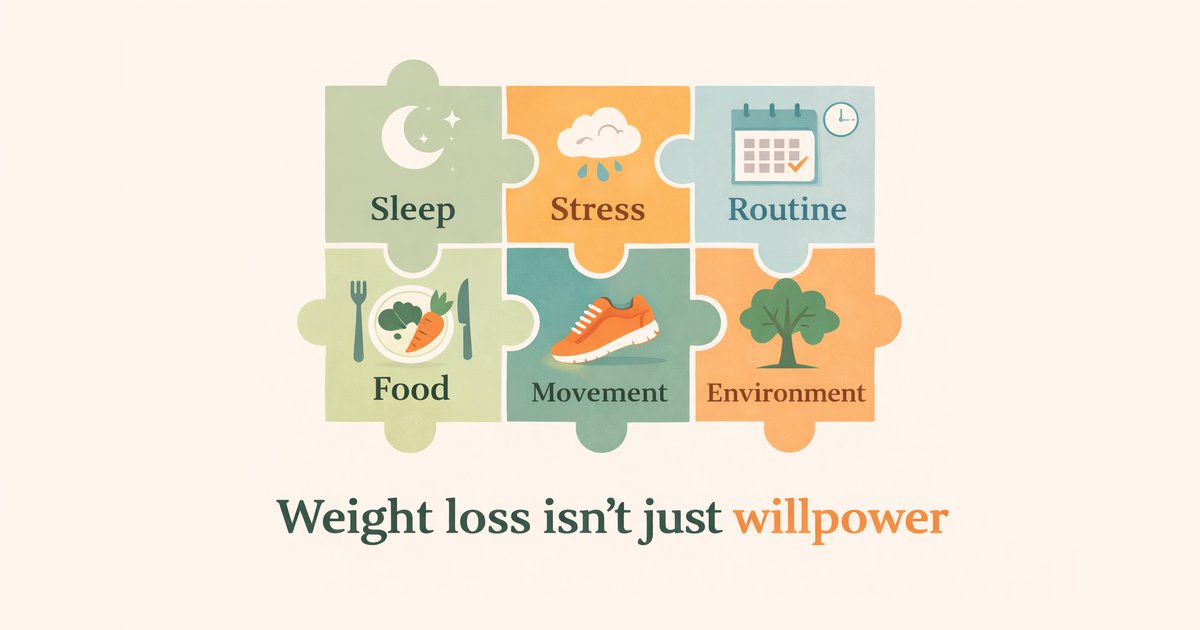
Why It’s More Complicated and What Helps
If weight management has ever felt like an uphill battle, you’re not alone — and it’s rarely as simple as “eat less, move more.” Body weight is influenced by a web of biology, environment, habits and lived experience. Understanding those influences can make weight goals feel more realistic, kinder, and far more achievable.
1) Genetics: the starting point, not the full story
Genetics can influence how efficiently your body uses energy, how readily it stores fat, and how strongly hunger and fullness signals are felt. Some people are more prone to higher appetite or a slower metabolic “set-up,” and a family history of obesity can increase risk — partly through inherited traits and partly through shared household habits. Importantly, genes are not destiny: consistent habits around food, movement, sleep and stress can still shift outcomes in a positive direction.
2) Social class: the invisible weight-management barrier
Socioeconomic factors can shape food access, free time, stress levels, and opportunities for activity. People on tighter budgets may rely more on cheaper, calorie-dense ultra-processed options because they’re accessible and filling. Long working hours or shift patterns can disrupt meal timing, sleep and routine movement. Education, confidence, and stress also play a role in the choices we make and the support we can access.
3) Food cost and availability: the “food environment” effect
Even with the best intentions, the local food environment matters. When healthier foods feel expensive, unavailable, or inconvenient, it’s easier to default to takeaways or packaged snacks. These choices are not a “character flaw” — they often reflect what’s practical in real life. Community and public-health initiatives can help, but on an individual level, small shifts (like choosing one or two “go-to” nutritious budget meals) can reduce reliance on convenience foods.
4) Lifestyle habits: snacking, distractions, sleep and stress
Modern life encourages grazing and distracted eating. Snacking on high-calorie foods, eating in front of screens, skipping meals and then overeating later, or using food to cope with stress and fatigue can all increase energy intake without feeling “big.” Sleep matters too: short sleep can increase hunger and reduce satiety, making cravings harder to manage. Mindful eating and more regular meals can help stabilise appetite and reduce impulsive snacking.
Two common weight-control models (and why neither is perfect)
The hormonal model
Hormones such as leptin, insulin, ghrelin and cortisol influence hunger, fullness and how the body uses energy. For example, restrictive dieting can increase ghrelin (hunger), chronic stress can raise cortisol (which may increase appetite for some), and insulin resistance can affect fat storage and appetite regulation. The limitation? Hormones don’t operate in isolation — they interact with lifestyle, environment, and behaviour, and not everyone experiences the same hormonal patterns.
The “Calories In vs Calories Out” model (CICO)
CICO is based on energy balance: over time, a calorie deficit tends to lead to weight loss, while a surplus tends to lead to gain. But it can be oversimplified. Food quality affects hunger and satiety, and prolonged restriction can trigger metabolic adaptation (the body conserving energy), making weight loss harder. Tracking is also imperfect: people misestimate portions, labels vary, and “calories out” differs between individuals.
The real-world takeaway: These models connect. Energy balance matters, but hormones, stress, sleep, food quality, muscle mass and routine movement all influence how easy (or hard) that balance feels.
Practical, sustainable strategies
- Aim for a modest calorie deficit rather than extreme restriction.
- Prioritise protein and fibre to support fullness.
- Protect muscle with resistance training (supports resting metabolism).
- Build daily movement (walking/NEAT) and choose activity you’ll repeat.
- Improve sleep and stress management to support appetite regulation.
- Reduce “auto-snacking” with simple structure (planned meals/snacks, mindful eating).
References
- Centers for Disease Control. Genes and obesity [Internet]. Available from: https://archive.cdc.gov/www_cdc_gov/genomics/resources/diseases/obesity/obesedit.htm (Accessed 8 October 2025)
- Journal of the Endocrine Society. Socioeconomic Status and Obesity [Internet]. 2024 Sep 26;8(11). Available from: https://academic.oup.com/jes/article/8/11/bvae176/7815057 (Accessed 8 October 2025)
- GOV.UK. Public Health England. Health matters: Obesity and the Food Environment [Internet]. 2019. Available from: https://www.gov.uk/government/publications/health-matters-obesity-and-the-food-environment/health-matters-obesity-and-the-food-environment–2 (Accessed 8 October
Disclaimer: This blog is for general information only and is not intended to diagnose or treat medical conditions. If you suspect a food allergy or have severe symptoms, seek medical advice.